The search engines have evolved beyond the matching of keywords to web pages. Nowadays, Artificial Intelligence (AI) has a significant contribution to the way search engines comprehend, prioritise, and present information to their users. AI assists search engines in understanding intent as well as large volumes of data, and applies more precise and intent-specific results.
With the further development of AI technology, people also search for online information differently, and businesses optimize their online content. The knowledge of the impact of AI in search can assist companies in adjusting their online marketing protocols and staying in the search engine results.
What Is AI in Search?
Artificial Intelligence in search refers to the application of machine learning models and advanced technologies in enhancing search engine understanding and the presentation of information.
Rather than using just keywords, AI-based search engines consider such factors as:
User intent
Context of the search query
Search history
Location
Content relevance
To illustrate, when a person is researching the idea of the most successful digital marketing strategies to use in the case of a small business, AI assists search engines in finding the pages that actually provide an answer to the question, but do not only include the keywords.
Better Understanding of User Intent
One of the biggest transformations in search through AI comes from better interpretations of user intent. Search engines now identify what users truly mean when they enter a query.
For example:
When one types in the query how to grow my business online, the search engine knows that the user can be seeking digital marketing solutions, tips on SEO, or social media marketing tips.
Companies that produce useful and informative content have higher chances of ranking high because AI rewards material that actually answers user queries.
More Personalized Search Results
According to AI, search engines can offer personalized results according to the behavior of the user. The user sees something based on previous searches, location, and browsing habits.
As an example, a person who enters the keyword of website design services in Kenya can get local companies at the top of the list, whereas a person entering the keyword in another country can get totally different results.
This implies that companies should maximize their websites and content to attract the correct audience.
A properly designed website that is easy to read and performs well is more visible in artificial intelligence-based search engines.
Voice Search and Conversational Queries
Voice search has also expanded with the help of AI in the form of digital assistants, such as Siri, Alexa, and Google Assistant. Users no longer type in brief keywords; instead, they can query in natural language.
For example:
Typed search
CRM benefits
Voice search
What are the advantages of a CRM system to a small business?
Due to this move, the businesses have to refine their content to fit the conversational search and place emphasis on straightforwardly answering questions.
AI and Content Quality
AI-based algorithms focus on high-quality content that brings real value to people. Informative, well-organized, and readable content has a higher chance of ranking high.
Search engines now evaluate:
Content relevance
Website authority
User engagement
Page experience
This is because businesses ought to concentrate on producing useful content instead of just adding keywords.
Faster and Smarter Search Results
With AI, search engines analyze billions of pages in a few seconds and provide the most relevant ones within seconds. Machine learning algorithms keep on improving, and this is based on user interactions.
As an illustration, when the user repeatedly clicks and spends time on some of the pages, the artificial intelligence will consider such pages useful, and they might be ranked higher during future searches.
The result is that through this continuous learning, the search engines are capable of giving results that are more accurate and useful as time goes on.
Conclusion
Artificial Intelligence is changing the search engine functionality and the way people access information on the web. AI has also made search smarter and more efficient by comprehending the intent of the users, personalizing search results, and focusing on high-quality content.
In the case of a business, there is a need to adjust to updated practices of SEO and work on generating valuable and user-centric content. Those companies that integrate good content planning, optimized websites, and good online marketing strategies will be in a better position to win the age of AI-enhanced search engines.
With the ever-evolving nature of AI, companies that keep up with the trends and adjust their approaches will have a great advantage in the online market.
Elon Designs assists entrepreneurs to go through this change by offering a search engine optimization strategy, optimized site structure, strategic planning of the content, and AI prepared online appearance that is in line with the functionality of modern search engines.
Are you willing to test your site and enhance your presence with AI-based search?
If you’ve been doing SEO the traditional way, you already know the rules: keywords, backlinks, technical structure, and consistency. But the way people search is changing fast. It’s no longer just about ranking on Google. It’s about showing up inside AI answers, chat results, and generative search summaries.
In this guide, we’re breaking down what it takes to make GEO work on your blog. Just simple strategies you can apply to make sure your content is discoverable and useful on both traditional search and AI-driven platforms.
What is GEO?
It simply means: Generative Engine Optimization.
It leverages AI and machine learning to enhance your content’s discoverability, unlike traditional SEO, which focuses on keywords and backlinks. Geo uses advanced algorithms to generate, optimize, and personalize content.
Instead of optimizing only search engines, you would now optimize for generative AI systems that summarize, recommend, and pull insights from other content. If your content is not structured properly, AI will not show it.
Comparison Between GEO and Traditional SEO
Traditional SEO is all about manual effort. This includes: you searching for the right keywords, doing backlinking, and depending on other websites to link to yours. Instead, in GEO, we mostly use AI to automate much of this heavy work. The AI then generates content around the topic based on current search trends and can even suggest different variations.
GEO takes a step further by generating engaging, relevant content tailored to your audience using AI.
Here’s the real difference:
Traditional SEO
Heavy manual keyword research
Backlink building campaigns
Focus on ranking position
Optimizing for search crawlers
GEO
Uses AI to identify search intent
Creates structured, answer-driven content Optimizes for AI summaries and recommendations
Focuses on topical authority and clarity
3.Setting Up Your AI Tools
To get started, you’ll need the right tools. Here are some of the top AI-powered tools that can help you optimize your content. For instance, GPT4 can generate high-quality text based on the brief you’ll provide.
Others can include:
SEO optimization tools
Jasper (formerly Jarvis)
Surfer
AI writing + research tools:
ChatGPT
Gemini
These tools help you:
Identify search intent
Generate structured outlines
Expand related questions
Optimize headings
Improve topical depth
The main goal is not to let AI write blindly. It’s to guide AI with the required strategic prompts.
4.Keyword Research with AI
Traditional SEO relies heavily on keywords, and GEO is no different. Keyword research might involve finding terms like: do-it-yourself kitchen gardening, etc. With AI tools, you can discover longer and more specific keywords. These long tail keywords often have fewer competitors and are highly relevant to a specific audience segment, and now comes the fun part, called generating content. AI can help you create high-quality blog posts in a fraction of the time.
Suppose you want to write a blog post about: the benefits of drinking water. Using AI-generated content, you can input this topic, and you let it improve it for you, in simpler terms, creating a draft.
The draft might include:
Introduction to the topic
Sections of the body
Conclusion and FAQS
Case studies
5.Content Optimization
GEO tools can analyze your text and suggest improvements. Imagine you’ve written a blog on how to fix your broken phone at home. Tools like Surfer SEO and Clearscope can analyze your draft and suggest adding other terms, as Grammarly does. This suggestion helps improve your content relevance and completeness, making it more likely to rank well on Google Platforms.
Remember, AI systems prefer well-organized content; a well structure increases visibility.
6. Continuous Improvement with AI Analytics
Finally, continuous improvement is crucial. One can use AI analytics to monitor performance and make data-driven decisions. This helps to check out what’s working and what’s not working to adjust the results.
Ready to Elevate Your Digital Strategy?
If you want content that ranks, gets referenced, and converts, you need more than basic SEO. You need a strategy built for the future of search.
Contact us today to discuss a custom digital marketing strategy that fits your goals.
AI Search Is Changing Everything: How to Optimize for ChatGPT, Perplexity, and Gemini
For decades, the rules of online discovery were written by Google. We ventured over keywords, backlinks, and meta descriptions, all to climb that coveted SERP (Search Engine Results Page). But a great revolution has been underway, and it’s conversational. The rise of generative AI search tools like ChatGPT, Perplexity, and Gemini isn’t just an upgrade; it’s a complete shift in the way people think or assume they are normal.
Instead of a list of blue links, users are getting direct, synthesized answers. This fundamentally changes how people find information and, consequently, how creators, marketers, and businesses need to think about visibility.
The question is no longer just “How do I rank on Google?” but “How do I become the source that these AI models learn from and cite?”
Let’s break down how to optimize for this new age of search.
The New Search Paradigm: From Links to Answers
Traditional search is reactive; you type a string of keywords and sift through results. Meanwhile, AI search is proactive and conversational. A user can ask Perplexity, “Plan a 2-day trip to Masai Mara National Reserve for a tourist, considering the current economy in Kenya,” and get a planned trip schedule with links to their sources.
One of the current goals will be to make your content one of those trusted sources, which requires a shift from keyword stuffing to authority-building.
Platform Specific Optimization Strategies
1. Optimizing for ChatGPT and Other AI
ChatGPT and similar chatbots are trained using massive datasets that are provided to them by their user and also the producers.
Focus on Long Tail Keywords: They target the actual and complex questions people are asking and create comprehensive content that answers not just the primary question but all the related sub-questions.
Create a definite “Source’ Content: A content creator should aim to create the most compelling, complete content resource on a topic.
Master the EEAT Principle: This stands for Experience, Expertise, Authoritativeness, and Trustworthiness. Google has been emphasizing this for years, and it’s now critical for current AI. Be transparent.
2. Optimizing for Google Gemini
Google is integrating its Gemini AI directly into Search Generative Experience (SGE)
Focus on Topical Authority: Google rewards sites that demonstrate deep expertise in a specific area. Create a hub of interlinked content that thoroughly covers every detail of your core topic. This includes technical SEO.
Implement the answer- first structure: For any page targeting an informational query, begin the main body of the content with a 2-4 sentence summary that provides the direct answer. Follow this immediate answer with your detailed explanation, steps, and examples. This structure makes it friendly for the AI to pull the core answer from its overview.
Double Down on User Intent: Google’s AI is mostly focused on satisfying the user’s intent. Analyze the search query; what are they looking for or comparing? Ensure your content matches that intent perfectly.
3. Optimizing for Perplexity AI
Perplexity is a search engine at its core, but with AI-powered summarization. It places a huge emphasis inciting its sources, making it a prime opportunity for visibility.
The Citation is the New Click-Through: Your main goal is to be one of the linked sources under Perplexity’s answer. This means your content must be highly relevant and authoritative on the specific query.
Data-Driven Content: Perplexity excels at answering complex, research-oriented questions. It creates content backed by data, statistics, and recent studies. Ensures all your data and facts are accurate and up to date.
Quality is Your Best SEO
While the tools are changing, the fundamental principle remains: create exceptional content for humans. AI models are trained to recognize and reward the quality of content.
The era of gaming the system with shortcuts is ending. The future belongs to creators, educators, and businesses that invest in becoming true authorities in their field. By optimizing for clarity, depth, and trust, you won’t just be optimizing for those AI, you’ll be future-proofing your online presence for whatever comes next.
From Noise to Noticed: Mastering AI Search Optimization for Brand Dominance
For decades, keywords ruled visibility. Now, master AI Search Optimization to dominate results on ChatGPT, Perplexity, and Gemini. Brands built their entire empires on gaming this system, stuffing articles with search terms, chasing backlinks, and obsessing over technical SEO. But that era is ending. We are leaving the age of Search Engines and entering the age of Answer Engines.
With the rise of AI models like ChatGPT, Claude, and Gemini, users are no longer looking for a list of blue links to sift through. They are looking for synthesized, immediate answers. This shifts the fundamental question for every business owner and marketer. When a potential customer asks an AI a question about your industry, does the AI know you exist? And if it does, does it recommend you?
Surviving this transition requires a radical mindset shift. It is no longer about optimizing for the search (SEO), it’s about optimizing for the machine’s understanding (Generative Engine Optimization). To dominate, you must stop being “noise” in a busy digital landscape and start being the signal that commands the conversation.
Here are six ways to build a brand that AI-powered search simply cannot bypass.
AI searches don’t just spit out random links; they look for the best answer. The first step in AI Search Optimization is to move beyond demographics and understand the specific questions, pain points, and desires of your audience. The goal is to create content that speaks directly to their needs, making you the primary source that AI recommends.
Go Beyond Demographics to “Search Intent” To achieve this, you must analyze the intent behind the search, not just the keywords. Is your audience looking for a quick definition (informational intent) or a solution to a complex problem (transactional intent)? When you tailor your content to match the specific stage of the buyer’s journey, you signal to AI algorithms that your content is highly relevant. This precision prevents your brand from being filtered out as generic noise and positions you as a tailored solution provider.
You must establish a continuous feedback loop to validate your understanding. AI is dynamic, and so are user behaviors. Utilize your customer support logs, social media comments, and sales inquiries to identify the exact language your customers use. When you mirror their vocabulary back to them in your content, you bridge the gap between their query and your solution. This semantic alignment is critical because AI models are trained to recognize patterns in language; speaking your customer’s “dialect” makes your brand easier for the AI to categorize and recommend.
2. AI Search Optimization for Conversational Queries
AI search engines thrive on natural language processing (NLP). Gone are the days when someone would simply type “best coffee machines.” Now, they ask complex questions like, “What is the best coffee machine for a beginner who wants espresso at home?” By optimizing for full sentences and question-based phrases, you position your brand as the “direct answer.” You need to anticipate the conversational flow, understanding that a user is likely looking for a dialogue, not just a list of links.
To win at conversational search, structure is just as important as keywords. AI bots often scan for concise definitions and clear lists to generate their answers. Use the “inverted pyramid” writing style: start with the direct answer to the question immediately, then expand on the details. This increases the chances of your content being picked up as a “Featured Snippet” or the direct answer in a voice search result, effectively making you the voice of authority for that topic.
Furthermore, you must anticipate the “follow-up” question. AI search experiences are often multi-turn conversations. If a user asks about “best coffee machines,” their next question might be “how to clean an espresso machine.” By clustering your content and linking related topics together, you create a “knowledge graph” on your own site. This helps AI understand the depth of your content, increasing the likelihood that it will keep users within your brand’s ecosystem for the duration of their entire search journey.
Search Demand Curve
3. Establish Authority through E-E-A-T
In the world of AI Search Optimization, credibility is king. Search algorithms now prioritize content based on E-E-A-T: Experience, Expertise, Authoritativeness, and Trustworthiness. Periodically publishing accurate, helpful, and well-researched content signals to the algorithms that you are a subject matter expert. It is not enough to just state facts; you must demonstrate that you have the background and the right to teach these facts.
Building authority also requires looking outside your own website. AI systems judge your trustworthiness based on who else cites you. Focus on Digital PR strategies, such as getting quoted in industry publications, collaborating with other experts, or publishing case studies. When high-authority sites link back to you or mention your brand, it acts as a “vote of confidence” that AI algorithms weigh heavily when deciding which brands to trust and recommend.
Additionally, pay attention to “Authorship.” AI models are getting better at identifying individual content creators. Ensure that your blog posts have clear author bylines with bios that highlight credentials. If the content is written by a recognizable expert in the field, AI is more likely to trust the validity of the information. By attaching a human face and reputation to your content, you differentiate yourself from the flood of anonymous, AI-generated spam that is currently clogging the internet.
Artificial intelligence pulls data from the entire internet, not just your website. It reads Reddit threads, LinkedIn comments, YouTube video transcripts, and social media posts. A dominating brand is seen wherever the audience is active, encouraging reviews and discussions that validate relevance. If your brand only exists on your website, you are invisible to a massive portion of the data that AI uses to form its answers.
You must also optimize for “multimodal” search. Remember that AI is not limited to text; it understands images, video, and audio. Ensure your images have descriptive alt-text, your videos have accurate captions, and your podcasts have transcripts. By making your non-text content accessible to AI crawlers, you open up new pathways for discovery. If a user searches for a visual concept or a tutorial, your optimized video or infographic could be the primary result they see.
Consistency across these platforms is the final piece of the puzzle. Your messaging, tone, and core value proposition must be aligned, whether a user finds you on TikTok, a podcast, or a blog. AI models look for patterns; if your brand information is contradictory across different platforms, it lowers your “trust score.” A unified brand voice reinforces your identity, making it easier for AI to synthesize a clear, accurate profile of who you are and what you offer.
5. Engage through Storytelling and Personality
While AI can easily process facts and data, it cannot replicate the human connection of a good story. Brands with a distinct voice and stories that evoke emotion stay top-of-mind. Storytelling ensures that even if an AI gives a factual summary of your product, the customer still seeks you out for the experience. It turns a transactional search into a relational interaction.
In an era of automated content, emotional resonance is the one thing AI cannot fully simulate. Share behind-the-scenes struggles, customer success stories, and the “why” behind your business. When content triggers an emotional response, humans are more likely to share it. These social signals, shares, likes, and comments, are data points that AI notices. A highly shared story signals to the search engine that your brand is culturally relevant and impactful.
Moreover, a strong brand personality acts as a defense mechanism against plagiarism. AI can scrape your facts, but it struggles to mimic a unique, nuanced brand voice without sounding derivative. By leaning into a specific tone, whether it’s witty, empathetic, or rebellious, you create a “moat” around your content. Users will learn to recognize your voice and prefer it over the dry, neutral summary provided by a chatbot, ensuring loyalty even in an AI-first world.
6. Monitor and Adapt Your AI Search Optimization Strategy
AI and search technologies are in a constant state of evolution. What worked today may not work tomorrow. Dominant brands must analyze trends, experiment with new formats like voice search or interactive tools, and adapt immediately to ensure visibility. Stagnation is the fastest route to irrelevance in a technological landscape that changes weekly.
You also need to change how you measure success. Traditional “rankings” matter less when an AI provides a zero-click answer. Instead, focus on metrics like “Brand Lift,” “Share of Voice,” and direct traffic. Are people searching for your brand by name after interacting with an AI tool? Monitoring these new KPIs (Key Performance Indicators) will give you a truer picture of your brand’s dominance than simply looking at which position you hold on a Google results page.
Finally, keep a close watch on the technical side of innovation. Tools like Schema Markup help you speak the AI’s language directly, organizing your data so it is easy for machines to parse. However, don’t get so lost in the tech that you forget the user experience (UX). AI recommends sites that are fast, mobile-friendly, and easy to navigate. By balancing technical innovation with a seamless user experience, you ensure that once the AI sends traffic your way, those visitors stay and convert.
Brands cannot simply rely on old strategies in the era of AI search. To succeed, you must understand your audience’s intent, optimize for conversational queries, build authority through E-E-A-T, and maintain a vibrant multi-platform presence.
Successful AI Search Optimization isn’t about being loud; it’s about relevance, trust, and humanness in a digital space where AI decides who gets noticed. By following these six strategies, your brand doesn’t just exist; it becomes the brand AI that your audience can’t ignore.
Ready to future-proof your brand? Start by auditing your current content strategy today to see if you are answering the questions your audience is actually asking. Elon Designs is here to guide you every step of the way from analyzing your existing content to crafting a strategy that truly connects with your audience. We ensure your website not only looks modern and professional but also delivers the answers and solutions your visitors are searching for, turning curiosity into conversions.
The Invisible Brand: Why SEO Is No Longer Enough in 2026
Traditional search is dead. If you are still obsessing solely over Google’s blue links while ignoring how ChatGPT, Gemini, and Perplexity talk about your brand, you are losing 40% of your potential traffic.
As entrepreneurs, we can’t afford to be invisible. Generative Engine Optimization (GEO) is the shift from “ranking for keywords” to “becoming the cited authority.” A 2024 Princeton study proved that simple GEO tweaks, like adding authoritative data and structured citations, can increase your brand’s visibility in AI answers by up to 40%. This isn’t just a trend; it is the new standard for digital survival.
SEO vs. GEO: What’s the Real Difference?
While SEO focuses on getting a “click,” GEO focuses on getting a “mention.”
Feature
Traditional SEO
Generative Engine Optimization (GEO)
Primary Goal
Rank #1 on Google Search
Be the “Cited Source” in AI answers
Key Metric
Click-Through Rate (CTR)
Brand Citations & Mentions
Content Style
Keyword-dense articles
Structured, authoritative facts
User Intent
Finding a list of links
Getting a direct, synthesized answer
7 Proven GEO Strategies for Entrepreneurs
1. Kill the Fluff: Answer Questions with “Zero-Click” Precision
AI engines are “answer machines.” They don’t want to read a life story; they want to solve a problem instantly. To rank in a Gemini or Perplexity response, your content must be the cleanest source of truth available.
The Strategy: Put the answer in the very first paragraph. Use the “Direct-Response Model.”
The Proof: AI engines prioritize content that is easy to summarize. If you can’t explain your product in one sentence, an AI won’t do it for you.
2. Hierarchy Over Hype: Use Logical Architecture
AI tools “crawl” your site to extract facts. If your blog is a wall of text, the AI will skip it for a competitor who uses Schema and Structured Headings.The Strategy: Use one H1, then H2s for main points, and H3s for details.
The Result: A clearer hierarchy leads to better “Rank Math” scores and easier extraction by AI bots.
3. Build “Topical Clusters” to Prove Expertise
AI favors websites that show niche authority rather than one-off posts. If you want to be the “expert” in AI’s eyes, you need to own the topic.
The Strategy: Link your blogs together. If you write about “GEO Tools,” link it to “GEO for Startups” and “GEO Case Studies.”
Internal Linking: This creates a “web” of information that proves to the AI you aren’t just guessing you are an expert.
4. Inject “Trust Signals” (Data & Experience)
AI filters out “generic fluff.” To be cited, your content needs E-E-A-T (Experience, Expertise, Authoritativeness, and Trustworthiness).
The Strategy: Include original data, author bios, and real-world case studies.The Fix: Replace “Many people say…” with “According to our 2025 internal audit…”
5. Write for Natural Language (Entities, Not Keywords)
People don’t talk to AI like they talk to Google. They ask questions: “How do I fix my SEO?”
The Strategy: Focus on “Entities” (your Brand Name + your Niche).
The Fix: Use conversational phrases. Instead of “SEO services Nairobi,” use “How our Nairobi-based agency helps entrepreneurs master SEO.”
6. Provide Actionable Frameworks and Lists
AI engines love Step-by-Step guides. They are the easiest content type for a bot to scrape and present as a “how-to” answer.
The Strategy: Use numbered lists for processes.
The Stat: Frameworks can boost AI citations by up to 67% because they provide immediate utility to the user.
7. The “Freshness” Audit
Information moves fast. AI engines like Perplexity prioritize recent data over old archives.
The Strategy: Refresh your top-performing blogs every 3–6 months.
The Fix: Update your statistics and add a “Last Updated” date to signal to the AI that your content is still relevant.
The Bottom Line: Help First, Sell Later
GEO is about becoming so useful that the AI has no choice but to mention you. Most of your competitors are still stuck in 2022. By implementing these seven steps today, you are future-proofing your business for 2026 and beyond.
Which of these GEO tactics will you implement first? Let’s discuss in the comments below.
Frequently Asked Questions About GEO
What is the main difference between SEO and GEO?
Traditional SEO focuses on ranking in Google’s blue links. GEO (Generative Engine Optimization) focuses on getting your brand cited as an authority within AI responses from tools like ChatGPT and Perplexity.
Does traditional SEO still work?
Absolutely. SEO is the foundation (site speed, mobile optimization), but GEO is the “authority layer” that ensures AI models trust your data enough to recommend it to users.
How do I start with GEO today?
The fastest way is to add Schema Markup and ensure your blog answers a specific question in the very first paragraph.
Is GEO only for big brands?
No. Small businesses and entrepreneurs can actually beat big brands in GEO by providing niche-specific, high-quality data that general websites overlook.
GEO is the practice of optimizing content so it’s more likely to be used or cited by generative AI systems (like ChatGPT, Google’s Gemini, Perplexity, Claude) rather than just ranking in a list of links. With AI tools like ChatGPT, Google Gemini, Claude, and Perplexity giving instant answers, authority, trust, and structured factual content matter more than keywords.
Multiple sources can appear in the same AI response, so the goal is not just to rank first, but to be a credible, citable source.GEO also brings new metrics, like tracking how often AI cites your content, and highlights the value of multimodal formats, including images, captions, and video with structured metadata.
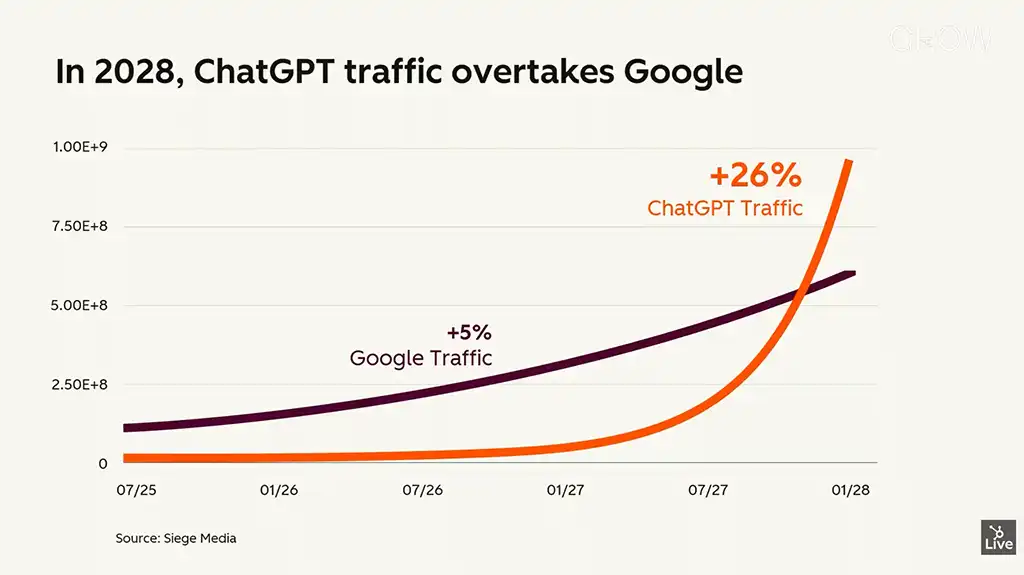
The data below predicts how effective GEO will be in the future years:
Why It Emerged
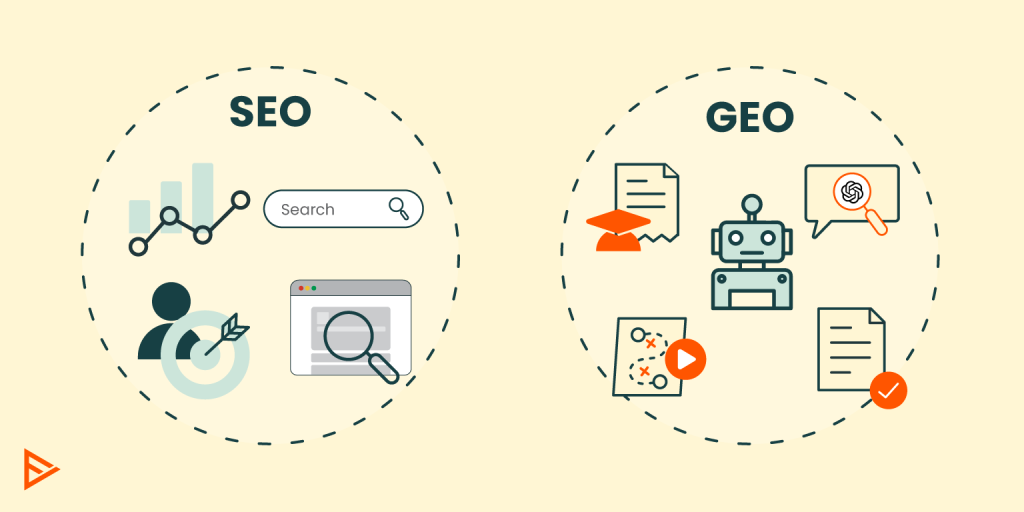
Traditional Search Engine Optimization (SEO) targets rankings in search engine results pages for clicks, while Generative Engine Optimization (GEO) aims to be cited directly within AI-generated answers. Key differences include: content focus(keyword density vs. topical authority) and technical approach( optimizing for crawlers vs. optimizing for AI comprehension via structured data)
Traditional SEO is about getting people to click into your site via search results. But generative AI gives synthesized, conversational answers directly, so the goal becomes being part of those answers.
Origins
The concept was formalized in academic research. The seminal paper by Aggarwal et al. introduced GEO as a paradigm to improve content visibility in generative engine responses.
Why GEO Matters: The Shift in Search Behavior
1. Zero-Click Answers Are Growing
With AI search, many users don’t click through to websites. AI overviews and synthesized answers directly satisfying their queries.
2. Authority & Trust Are Key
Generative models tend to favor content that’s authoritative, structured, and well-sourced. Having strong citations, clean data, and trusted entities improves your chance of being referenced.
3. Different Competitive Dynamics
In GEO, multiple sources can be cited in the same AI-generated answer. It’s not just about beating rivals for a top spot; it’s about earning a place as a trusted, citable resource.
4. New Metrics for Success
Rather than tracking keyword ranking or backlinks, you might track how often your content is cited in generative responses, or how visible you are across different AI models.
5. Multimodal Content Matters
Research is already suggesting that optimizing for images, captions, or even video (with structured, machine-readable metadata) will improve your chances in generative engines.
6. Engine-Specific Strategies
Different AI engines have different retrieval behaviors, which may not be optimal for Gemini or Claude. GEO encourages tailored strategies per engine.
Risks & Challenges
1. Opacity
These generative AI systems are often black boxes. It’s not always clear which signals the model is prioritizing.
2. Authority Bias
There’s a risk that big, established brands or highly authoritative sources dominate AI citations, making it harder for smaller or niche creators.
3. Content Authenticity
Because AI prioritizes reliability and citations, content must be factual, well-referenced, and structured; fluff or marketing speak will not suffice.
4. Resource Intensive
Optimizing for GEO may require more work than traditional SEO; you need structured data, entity mapping, and consistent content formats that are AI-friendly.
Strategic Implications: What Marketers & Content Creators Should Do
5. Audit for AI Readability
Review existing content. Are your pages structured in a clear, semantically rich way? Are there data, statistics, or expert quotes?
6. Use Structured Data & Metadata
Implement schema markup, use entity identifiers, and set up “llms.txt”-style signals (or similar) to help AI systems understand and cite your content.
7. Build Authority Through Earned Media
Thought leadership, guest pieces, research anything that helps you be seen as a credible source is increasingly valuable in GEO.
8. Produce Conversational Content
Format content around real questions, use FAQs, micro‑headings, and make it easy for an AI to extract concise, relevant info.
9. Monitor AI Mentions
Use tools (or future GEO dashboards) to track how often your brand/content is being cited by generative models.
10. Think Long Term
Because this is an evolving space, invest in GEO now, but continue to maintain traditional SEO. It’s not an either/or; it’s a new layer.
Big Picture: How Search Rankings Are Being Redefined
Power Shift
Search is no longer just about ranking on Google. AI-driven systems are becoming gatekeepers, and being cited by them is a new form of visibility and influence.
Redefined “Real Estate”
In the traditional SEO world, page 1 on Google was prime real estate. In the GEO era, generative real estate means being included in the AI’s answer; that’s the new premium spot.
SEO and GEO results for Hybrid Future
For most organizations, SEO will still matter, but optimizing for AI (GEO) becomes essential. The most successful digital strategies will blend both.
Content Quality Gets Elevated
With citation, trust, and structure being more important, low-quality or superficial content is less likely to be favored by generative engines.
Bottom Line: The Future is Hybrid
Search is no longer a single battlefield. The prime real estate is expanding from the top of Google’s page to inside the AI-generated answer. The most successful digital strategies will be hybrid, blending the traffic-driving power of traditional SEO with the citation-focused approach of GEO.
Generative Engine Optimization isn’t just a buzzword; it’s a real paradigm shift. As AI-powered search becomes more widespread, brands and creators need to rethink how they design content for visibility in AI-generated answers, not just for link-based rankings.
If you want to future-proof your content strategy, GEO should be a core part of your roadmap, not just an optional add.