Category: Web Hosting

  • How to Build a Coaching Website in Kenya That Gets More Clients.

    How to Build a Coaching Website in Kenya That Gets More Clients.

    The growth of coaching in the digital economy in Kenya is increasing fast paced in the present day but so is the competition. No matter whether you are a mentor, a business coach, a fitness trainer or a life coach, one thing is clear; social media is not sufficient to get constant clients.

    You can receive views, likes, and even messages but without organizing those views the majority of that attention will not translate into paying clients.

    This is why any serious coach has to have a professional website.

    A coaching site is not another internet profile. It is your online office, sales pipeline, and customer acquisition platform operating 24/7. It generates trust, makes you an expert and allows clients to make reservations and payments easily without hassle.

    This is the guide on how to actually start a coaching site in Kenya and it does not only exist but the one that can continue to deliver clients to you.

    The reason why Coaches in Kenya need a Website (Now More Than Ever).

    A lot of coaches count on such platforms as Instagram, Tik Tok, and WhatsApp. Although these platforms are effective in terms of visibility, they are associated with critical limitations:

    • The platform is not in your control.
    • Algorithms limit your reach
    • There are interspersed conversations.
    • No definite customer journey.
    • The booking and payment is cumbersome and time consuming.

    A web site will do all this because it provides you with:

    • The ability to have complete control over your brand and content.
    • A business photo that creates immediate confidence.
    • An obvious line between the visitor and the client.
    • Bookings and payment automation.
    • One point of focus on all your marketing work.

    All of your social media traffic should then be redirected to your site which will then convert attention to real revenue.

    The Essentials of a Coaching Website with High Conversion.

    Your web site should not just look good but should also lead people to take some action in order to obtain real results.

    1. An Excellent and Memorable Value Statement.

    The following questions should be answered within the first 5 seconds:

    • Who do you help?
    • What problem do you solve?
    • What result do clients get?

    Example:

    The mission of the company is to assist Kenyan entrepreneurs in establishing successful and profitable organizations by using personalized coaching methods.

    Being clear brings trust – and trust brings conversions.

    2. A Seamless Booking System

    Clients will not stay on board in case they find it hard to book you.

    A reservation system enables customers to:

    • See your availability on the real-time basis.
    • Book schedules in real-time.
    • Auto confirmations and reminders.

    Apps such as Calendly are easily incorporated into your site, which removes the back-and-forth conversations.

    This is one of the most significant characteristics to transform visitors into clients.

    3. In-app payments (Kenya version)

    Clients should easily pay as soon as they book through your website.

    Suggested methods of payment:

    • M-PESA (needed among Kenyan users)
    • Debit/Credit cards
    • Bank transfers

    Combining booking and payment into a single flow eliminates friction, and converts people to customers by a significant margin.

    4. Testimonial and Social Proof.

    Individuals believe in outcomes, rather than promises.

    Your website should include:

    • Client testimonials
    • Success stories
    • Before-and-after transformations
    • Screenshots of feedback

    This will convince the potential clients that your coaching is a value-added service.

    5. Well-Identified Coaching Services.

    Keep it simple: make your offers clear:

    • One-on-one coaching
    • Group coaching programs
    • Masterclasses and workshops.
    • Online courses

    Each service should include:

    • What’s included
    • The benefits
    • Pricing (or a call to inquire)
    • Good call-to-action (e.g., Book Now).

    6. Scalable Income Course Hosting.

    In case you would like to go beyond one-on-one, you have to productize your knowledge.

    This is where such platforms as SasaLearn LMS enter.

    You can with a learning management system:

    • Design and market e-learning.
    • Automate training delivery
    • Contact more customers without having to work harder.

    Develop sources of passive income.

    Using this as an example, you need not repeat the same training, but you can design one course which you sell to hundreds of learners.

    • The Ideal Coaching Web Site Design.
    • An effective site has a clear layout which directs the visitors on how to go about it.
    • The Coaching Website Ideal Structure.
    • The well-designed web site takes the visitors through steps.

    Homepage

    Your homepage should:

    • Grab attention immediately
    • Explain what you do
    • Highlight your services
    • Show testimonials
    • Encourage booking

    About Page

    Here is where individuals associate with you.

    Share:

    • Your story
    • Your experience
    • Your mission

    Consumers purchase products of persons whom they have trust.

    Services Page

    Clearly outline:

    • What you offer
    • Who it is for
    • What deliverables will the clients get.
    • Always have a good call-to-action of Book Now.

    Blog Section

    Your blog would enable you to draw customers via Google.

    By posting useful content, you:

    • Improve your visibility
    • Build authority
    • Educate your audience

    Contact Page

    Ease the access of clients by:

    • Phone
    • Email
    • WhatsApp
    • Contact forms

    How Booking Systems Transform Your Business

    The inclusion of a booking system alters your operations.

    Instead of:

    • There is too much WhatsApp chatting.
    • Scheduling confusion
    • Missed opportunities

    You get:

    • Instant bookings
    • Automated confirmations
    • An experience with a professional client.

    This saves time not only- it brings more income.

    Scaling with SasaLearn LMS

    The most competent coaches do not sell time rather they create systems.

    With SasaLearn LMS, you can:

    • Transfer the knowledge into structured courses.
    • Develop several clients simultaneously.
    • Create recurring revenue
    • Build long-term impact

    As an illustration, rather than doing the same training over and over again, you can package the training into a course and sell it to a hundred learners.

    The Ultimate Guide to Acquiring Clients via Google (SEO Tips).

    Your website should be visible to clients online in order to attract them.

    Here’s how:

    • The keywords such as coaching website Kenya should be used naturally.
    • Write helpful blog content
    • Make your website mobile-friendly.
    • State your place (Kenya, Nairobi)
    • Make your web site quick and minimal.

    SEO is not as fast as it has long-term and consistent results.

    Common Mistakes to Avoid.

    Avoid these common issues:

    • No clear message
    • No booking system
    • Poor design on mobile
    • No testimonials
    • Making your site too complicated.

    It is simplicity and clarity that prevails.

    The most frequently asked questions (FAQs).

    1. Is a website necessary to coaches in Kenya?

    Yes. A site will make you gain responsibility, appear professional and transform visitors into paying customers better than a social media platform would.

    2. So what to put on a coaching website?

    An effective coaching site ought to include a home page, an about page, the services page, a booking page, payment method page, testimonials, and contact information.

    3. What will be the way clients can book sessions with me through my website?

    You can combine the usage of such tools as Calendly that enable clients to consider your availability and make a book without two-way communication.

    4. Is it possible to accept payments on M-Pesa through my coaching site?

    Yes. You can combine M-pesa with other forms of payment to ensure that your Kenyan clients pay easily to use your services.

    5. What would a website do to make me attract more coaching clients?

    A web site will draw the clients using Google and social media and transform them with concise communication, trust components and convenient reservation systems.

    Conclusion.

    A coaching site is not an online possession, it is a customer-making machine.

    It helps you:

    • Build trust
    • Attract the right audience
    • Transform visitors into clients.
    • Automate your business
    • Scale your income

    The victorious coaches in the current competitive market are not only competent  but visible and planned.

    All this is compiled on your site.

    Want a professional website that actually generates leads?

    Explore our services:
    https://elondesigns.com/services/web-design

    View full pricing:
    https://elondesigns.com/pricing

    Ready to start? Contact us today for a custom quote.

  • Website Development Cost in Kenya: 2026 Ultimate Pricing Guide (Honest Breakdown + Real Costs)

    Website Development Cost in Kenya: 2026 Ultimate Pricing Guide (Honest Breakdown + Real Costs)

    Website Development Cost in Kenya: Honest Pricing Breakdown

    If you’re planning to build a website, one question always comes first: what is the real website development cost in Kenya in 2026?

    The truth is, website pricing in Kenya is not fixed. It varies depending on design quality, features, developer experience, and long-term needs. Some businesses spend as little as KSh 35,000, while others invest over KSh 500,000+ for advanced systems.

    In this complete guide, we break down everything, no hidden costs, no vague estimates—just real numbers.

    Website Development Cost Kenya Overview

    Understanding website development cost in Kenya starts with knowing what you’re actually paying for.

    A website is not just “pages on the internet.” It includes:

    • Design (how it looks)
    • Development (how it works)
    • Hosting (where it lives)
    • Domain (its name)
    • Maintenance (keeping it running)

    Average Cost Range in Kenya (2026):

    • Starter websites: KSh 35,000+
    • Professional business sites: KSh 80,000 – KSh 150,000
    • E-commerce platforms: KSh 100,000 – KSh 250,000
    • Custom systems: KSh 200,000+

    Types of Websites in Kenya (Detailed Pricing)

    Basic Website Cost in Kenya

    Basic websites are simple but effective. They are perfect for getting online quickly without complex features.

    Typical Pages:

    • Home
    • About
    • Services
    • Contact

    Cost Breakdown:

    • Design: KSh 10,000 – 25,000
    • Development: KSh 20,000 – 40,000
    • Total: KSh 35,000 – 80,000

    Best for:

    • Startups
    • Personal brands
    • Small businesses

    These websites focus on visibility, not advanced functionality.

    Business Website Cost in Kenya

    Business websites are more robust and built for growth.

    Key Features:

    • Blog system
    • SEO optimization
    • Lead capture forms
    • Professional branding

    Cost Breakdown:

    • Design: KSh 20,000 – 50,000
    • Development: KSh 50,000 – 100,000
    • Total: KSh 80,000 – 150,000

    Best for:

    • SMEs
    • Service providers
    • Corporate companies

    This is the most popular category in Kenya.

    E-commerce Website Cost in Kenya

    E-commerce websites allow you to sell products online with payment integration.

    Key Features:

    • Product listings
    • Shopping cart
    • M-Pesa integration
    • Order management

    Cost Breakdown:

    • Design: KSh 30,000 – 80,000
    • Development: KSh 70,000 – 170,000
    • Total: KSh 100,000 – 250,000

    Best for:

    • Retail businesses
    • Online shops
    • Wholesalers

    Custom Website Development Cost

    Custom websites are tailored systems built from scratch.

    Examples:

    • Booking systems
    • SaaS platforms
    • Marketplaces

    Cost:

    • Starting from KSh 200,000 to 1M+

    These require advanced development and longer timelines.

    Detailed Website Pricing Table (Kenya 2026)

    Website TypeDesign Cost (KSh)Development Cost (KSh)Total Cost (KSh)Best For
    Basic Website10,000 – 25,00020,000 – 40,00035,000 – 80,000Small businesses
    Business Website20,000 – 50,00050,000 – 100,00080,000 – 150,000SMEs
    E-commerce Website30,000 – 80,00070,000 – 170,000100,000 – 250,000Online stores
    Custom Website50,000 – 200,000150,000 – 800,000200,000+Enterprises

    Website Design Cost Breakdown

    UI/UX Design Costs

    Good design improves user experience and conversions.

    • Simple design: KSh 10,000
    • Advanced UI/UX: KSh 50,000+

    A well-designed website builds trust instantly.

    Development Costs

    This includes coding and functionality.

    • Frontend: KSh 20,000 – 100,000
    • Backend: KSh 30,000 – 150,000

    More features = higher cost.

    Content & SEO Costs

    Content is what drives traffic.

    • Content writing: KSh 3,000 – 10,000/page
    • SEO setup: KSh 10,000 – 50,000

    Hosting Costs in Kenya Explained

    Hosting keeps your website online.

    Hosting TypeCost Per Year (KSh)Best Use
    Shared Hosting3,000 – 10,000Small sites
    VPS Hosting10,000 – 30,000Growing businesses
    Cloud Hosting20,000 – 100,000+High traffic

    Domain Name Pricing in Kenya

    Your domain is your brand online.

    Domain TypeCost (KSh/year)
    .co.ke1,000 – 2,500
    .com1,200 – 3,000

    Website Maintenance Cost Kenya

    Maintenance ensures your site runs smoothly.

    ServiceMonthly Cost (KSh)
    Basic maintenance5,000
    Standard support10,000 – 20,000
    Advanced support20,000 – 30,000

    Hidden and Additional Website Costs

    Many people overlook these:

    • SSL certificates
    • Premium plugins
    • Email hosting
    • Marketing tools

    These can add KSh 10,000 – 100,000+ yearly

    Factors Affecting Website Development Cost in Kenya

    Prices vary due to:

    • Project complexity
    • Developer experience
    • Custom vs template design
    • Number of pages
    • Integrations (payments, APIs)

    Freelancers vs Agencies in Kenya

    FactorFreelancerAgency
    CostLowerHigher
    ReliabilityMediumHigh
    SupportLimitedFull
    ExpertiseVariesProfessional

    Why Website Prices Vary So Much

    This is one of the most misunderstood aspects of website development in Kenya.

    Reasons include:

    • Different skill levels
    • Use of premium tools
    • Customization depth
    • Business goals

    A KSh 40K website is not the same as a KSh 150K one.

    Is Cheap Web Design Worth It?

    Short answer: Not always.

    Cheap websites often lead to:

    • Poor SEO performance
    • Slow loading speed
    • Security issues
    • Redesign costs later

    Investing more up front saves money long-term.

    Frequently Asked Questions (FAQs)

    1. How much is the website development cost in Kenya in 2026?

    Between KSh 35,000 and KSh 250,000+, depending on the type.

    2. Why is website development expensive?

    Because it involves design, coding, hosting, and ongoing maintenance.

    3. Can I build a website cheaply?

    Yes, but quality and scalability may be limited.

    4. What is the monthly cost of a website in Kenya?

    Between KSh 5,000 and KSh 30,000 for maintenance.

    5. How long does it take to build a website?

    • Basic: 1–2 weeks
    • Business: 2–4 weeks
    • E-commerce: 4–8 weeks

    6. Do I need hosting and a domain separately?

    Yes, both are essential for your website to function.

    Conclusion: What Should You Budget?

    The real website development cost in Kenya depends on your goals.

    • Small business? → Budget KSh 50K – 100K
    • Growing company? → Budget KSh 100K – 200K
    • Advanced platform? → Budget KSh 200K+

    Want a professional website that actually generates leads?

    Explore our services:
    /services/web-design

    View full pricing:
    https://elondesigns.com/pricing

    Ready to start? Contact us today for a custom quote.

  • 3 Types of Web Hosting You Should Consider in 2026 as an Entrepreneur 

    3 Types of Web Hosting You Should Consider in 2026 as an Entrepreneur 

    What is Web Hosting and Why Does it Matter?

    The three most effective web hosting types in 2026 are Shared NVMe Hosting for beginners, Virtual Private Servers (VPS) for growing agencies, and Managed Cloud Hosting for high-traffic enterprises. While shared hosting remains the most affordable entry point, the rise of “Interaction to Next Paint” (INP) as a critical SEO metric means that migrating to VPS or Managed Cloud is now a strategic necessity for any business looking to rank on the first page of AI-driven search results. The Evolving Landscape of Web Hosting in 2026: A Strategic Imperative

    The year 2026 marks a significant inflection point in the web hosting industry, driven by escalating performance demands and the critical influence of Artificial Intelligence (AI) on search engine ranking algorithms. No longer is web hosting a mere commodity; it is a foundational strategic asset directly impacting a business’s discoverability, user experience, and bottom line.

    Currently, the hosting landscape is neatly segmented into three dominant tiers, each catering to distinct business needs and growth stages:

    1. Shared NVMe Hosting: The Entry Point (Ideal for New Users and Startups)

    In 2026, “Basic Shared Hosting” will be replaced by Shared NVMe Hosting. Unlike the slow HDD or SATA SSD drives of the past, NVMe (Non-Volatile Memory Express) storage connects directly to the server’s PCIe bus, offering data transfer speeds up to 10x faster than traditional SSDs.

    Who it’s for:

    • New bloggers and personal portfolios.
    • Local businesses in Kenya that are just starting their digital journey.
    • Small sites with under 10,000 monthly visitors.

    The 2026 Edge:

    Modern shared hosts now include AI-driven resource management. This technology prevents the “noisy neighbor” effect, where one site’s traffic spike slows down everyone else on the server by using AI to dynamically isolate and throttle resource-heavy scripts in real-time.

    This tier remains the most economical and accessible starting point for new websites, blogs, and small projects. The key differentiator in 2026 is the ubiquitous adoption of Non-Volatile Memory Express (NVMe) storage. This modern, high-speed storage technology, replacing older SATA and even standard SSDs, provides a dramatic performance uplift, ensuring that even the lowest-cost hosting option offers reasonable speed.

    • Key Advantage: Lowest cost, simplicity of use, and included control panels.
    • Best Suited For: First-time website owners, personal blogs, very small business sites, and low-traffic proof-of-concept projects.

    2. Virtual Private Servers (VPS): The Growth Accelerator (Perfect for Expanding Agencies and SMEs)

    A VPS uses virtualization technology to give you dedicated resources on a shared physical machine. In 2026, the standard is KVM (Kernel-based Virtual Machine) virtualization, which ensures that your allocated RAM and CPU are strictly yours and cannot be “borrowed” by other users.

    Why it’s a Game-Changer for Agencies:

    For digital marketers and administrators at companies like Elon Designs Ltd, a VPS offers the control needed to run custom marketing scripts and heavy design tools without lag.

    • Root Access: You can install custom server-side software (like specialized SEO crawlers).
    • Dedicated IP: Reduces the risk of being blacklisted due to another site’s spammy behavior, a common issue in shared environments.
    • Scalability: You can “hot-swap” or add more RAM and CPU cores during a major marketing campaign without any downtime.

    Technical Note: In 2026, look for VPS providers offering Cloud-hosted Control Panels. These allow you to manage your server through a simple interface (like hPanel or a modern cPanel) while keeping the raw power of a dedicated environment.

    The Virtual Private Server (VPS) environment represents the essential middle ground, offering a perfect blend of dedicated resources, control, and scalability at a moderate price. A VPS partitions a physical server into several virtual environments, with each user guaranteed a specific allocation of CPU, RAM, and storage. This isolation eliminates the “noisy neighbor” effect common in shared hosting, where one high-traffic site can slow down all others.

    • Key Advantage: Dedicated resources, root access for custom configuration, superior stability, and enhanced security.
    • Best Suited For: Growing small-to-medium enterprises (SMEs), e-commerce stores, web development agencies managing multiple client sites, and applications requiring custom software stacks.

    3. Managed Cloud Hosting: The Enterprise Powerhouse (The Go-To for High-Traffic, Mission-Critical Businesses)

    Managed Cloud Hosting is the “gold standard” for 2026. Instead of your site sitting on one physical server, it lives on a network of interconnected virtual servers. If one server fails, another takes over instantly.

    The “Managed” Advantage:

    The “Managed” part means the host handles the heavy lifting:

    • Automatic Core Updates: WordPress, PHP, and security patches are handled for you.
    • Edge Computing: Your site’s HTML is cached at “Edge” nodes globally, meaning a user in Nairobi sees your site just as fast as a user in New York.
    • Predictable Pricing: Unlike older cloud models, 2026 providers often offer “Capped Pricing” to avoid surprise bills from traffic surges.

    Essential for SEO:

    Managed Cloud hosts are now built with Generative Engine Optimization (GEO) in mind. They provide the extreme speed and structured data uptime required for AI agents (like Gemini or ChatGPT) to crawl and cite your website as a reliable source.

    Managed Cloud Hosting stands as the premier solution for businesses that cannot afford a moment of downtime and experience unpredictable, massive traffic spikes. This model leverages a distributed network of servers, allowing resources (like CPU power and memory) to be scaled up or down instantly and automatically in response to demand. The “managed” aspect ensures that all server maintenance, security updates, and performance tuning are handled by the provider’s expert team.

    • Key Advantage: Near-infinite scalability, unparalleled reliability, built-in redundancy, automatic load balancing, and expert maintenance.
    • Best Suited For: Large e-commerce platforms, enterprise applications, high-traffic media outlets, SaaS (Software as a Service) companies, and sites with global audiences.


    Which One Should You Choose?

    FeatureShared NVMeVPS HostingManaged Cloud
    PerformanceModerate (Fast Burst)High (Consistent)Elite (Global Edge)
    Price (Monthly)KES 500 – KES 1,500KES 2,500 – KES 8,000KES 4,500+
    Technical SkillZero (Beginner)IntermediateLow (Host Manages It)
    Best ForStartupsAgencies / Digital MarketersE-commerce / Global Brands


    The Strategic Imperative: The Rise of INP and AI-Driven SEO

    While Shared NVMe Hosting offers a cheap start, the shift in search engine optimization (SEO) priorities makes an upgrade a necessary strategic move for any business aiming for market visibility. The driving force behind this is the increasing importance of the Core Web Vitals metric “Interaction to Next Paint” (INP).

    INP measures the responsiveness of a website by evaluating the time from when a user interacts with a page (e.g., clicking a button or link) to the moment the browser paints the next visual frame. In 2026, INP has become a key ranking factor, reflecting Google’s focus on real-world user experience. A poor INP score, often caused by slow server response times or insufficient computational power (common issues on overloaded shared servers), can directly impede a site’s ability to achieve a top ranking.

    This performance requirement, coupled with the reliance of modern search results on AI-driven algorithms that prioritize fast, responsive, and seamless user journeys, means that migration to a VPS or Managed Cloud environment is crucial. Businesses serious about competing in today’s digital landscape must view this hosting upgrade not as an expense, but as a mandatory investment in site performance, SEO health, and, ultimately, sustained business success.

    Frequently Asked Questions

    1. Is shared hosting still a good idea in 2026?

    Yes, but only if it uses NVMe storage. In 2026, standard HDD or older SSD shared hosting will be too slow for modern search engines. Shared hosting is ideal for sites with under 25,000 monthly visits. However, if you are running an e-commerce store or a site with heavy dynamic content (like a learning management system), the “noisy neighbor” effect of shared hosting may hurt your performance.

    2. How does hosting affect my SEO in 2026?

    Hosting is now a primary SEO factor. Google’s Core Web Vitals and the new INP (Interaction to Next Paint) metric measure how fast your server responds.

    • Latency: High latency can lead to “zero-click” abandonment.
    • AI Crawling: If your server is slow, AI agents (like Gemini or ChatGPT) may fail to index your content, meaning your site won’t be cited in AI search summaries.

    3. Do I need technical skills to use a VPS?

    Not necessarily. In 2026, most providers offer Managed VPS options. This gives you the power of a private server while the hosting company handles security patches, server updates, and backups. If you choose an unmanaged VPS, you will need to be comfortable with the Command Line Interface (CLI) and server hardening.

    4. What is “Green Hosting,” and why is everyone talking about it?

    Green hosting refers to data centers powered by 100% renewable energy or those that purchase carbon offsets. In 2026, sustainability has become a “trust signal.” Many corporate clients now require their partners to use eco-friendly infrastructure as part of their ESG (Environmental, Social, and Governance) goals.

    5. Can I host a Kenyan business on a US or European server?

    You can, but it may increase your TTFB (Time to First Byte) for local visitors. For businesses targeting customers in Nairobi or Limuru, it is best to use a provider with an Edge node in Kenya or a local host like HostAfrica. This ensures that the data doesn’t have to travel across the ocean, making your site feel “instant” to local users.

    6. Why is my renewal price so much higher than the signup price?

    This is a common “introductory rate” tactic. In 2026, savvy marketers check the Renewal Transparency policy. Always look for the “post-offer” pricing in the fine print. Some modern hosts are moving toward Flat-Rate Pricing, where the price you sign up with is the price you pay forever.

    7. What security features are “must-haves” this year?

    At a minimum, your 2026 hosting plan should include:

    • Free SSL (TLS 1.3): Essential for encryption.
    • Automated Daily Backups: Preferably stored in a different physical location (Off-site).
    • DDoS Protection: To block malicious traffic spikes.
    • WAF (Web Application Firewall): To stop bot attacks before they reach your WordPress dashboard.

    Ready for a faster website? Click here: cloudelona.com to View Our Secure Hosting Packages or Contact Our Team for a Free Consultation.

    Email: [email protected]

    Call / WhatsApp: +254 724 636 436

  • How Web Hosting Affects Sales: 3 Critical Ways It Kills Revenue

    How Web Hosting Affects Sales: 3 Critical Ways It Kills Revenue

    To understand exactly how web hosting affects sales, imagine hiring the best salesperson in the world. They are charming, knowledgeable, and persuasive. But every time a customer walks up to ask a question, this salesperson freezes and stays silent for 10 seconds.

    The customer doesn’t wait. They walk away.

    Your web hosting is that salesperson.

    Many business owners spend thousands on marketing, yet they ignore the website infrastructure that powers it all. They don’t realise the impact until they see their conversion rates flatline.

    Data from Google Developers shows that as page load time goes from 1 second to 3 seconds, the probability of a user leaving increases by 32%.

    In this guide, we will break down the 3 critical ways your server impacts your bank account and help you diagnose if your host is costing you money.


    1. How Web Hosting Affects Sales Through Speed

    In the eyes of search engines like Google, speed is a ranking factor known as Core Web Vitals. Specifically, they measure TTFB (Time to First Byte), which is how long it takes your server to “wake up” when a customer clicks a link.

    Over half of global web traffic comes from smartphones, which often rely on unstable data connections rather than fast Wi-Fi. It is crucial to consider these mobile users. If you want to see a real-world example of how web hosting affects sales, look at your mobile bounce rates. If your hosting server is not optimised for rapid content delivery, mobile shoppers are unlikely to wait for a slow page to load; they will quickly move on to the next result in their search.

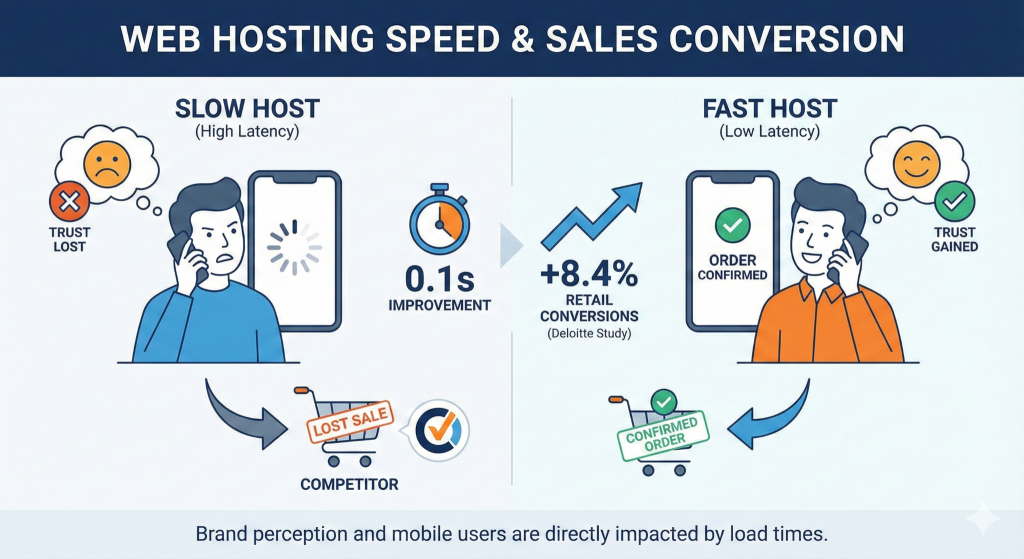
    Site speed significantly influences not only technical rankings, page speed but also brand perception. According to a Deloitte study, a mere 0.1-second improvement in load times can boost retail conversions by 8.4%. An instantly loading website projects competence and reliability to a customer, whereas a slow or lagging site can subtly suggest that the business is disorganised or outdated.

    • The Conversion Drop: Research has shown that a mere 0.1-second delay in page load can cause a 1% drop in sales.
    • The Danger Zone: If your hosting server is slow, customers assume your checkout process will be slow (and risky) too. They abandon their carts.
    image
    WEB HOSTING SPEED & SALE CONVERSION

    Bottom line: If your host is slow, your marketing ROI is being wasted on visitors who leave before your site even loads.

    The “Mobile-First” Reality Check

    It is impossible to talk about how web hosting affects sales without discussing mobile users. In Kenya and across Africa, over 70% of web traffic is mobile.

    Mobile phones have less processing power than desktop computers, and they often rely on unstable 4G data networks. This makes your hosting performance twice as important.

    • The “Heavy” Site Problem: If your hosting server is slow to respond (high latency), a mobile phone will struggle to render your site. The user sees a white screen for 5 seconds.
    • The Result: They hit the “Back” button. Google tracks this “Pogo-sticking” behaviour (users clicking your link and immediately bouncing back) and will penalise your SEO rankings for it.

    Pro Tip: High-quality hosting often comes with a built-in Content Delivery Network (CDN). A CDN stores copies of your website on servers all over the world. If a customer visits your site from Mombasa, the CDN serves the site from a server nearby, rather than one in Europe or the US. This single feature can cut your mobile load times in half.

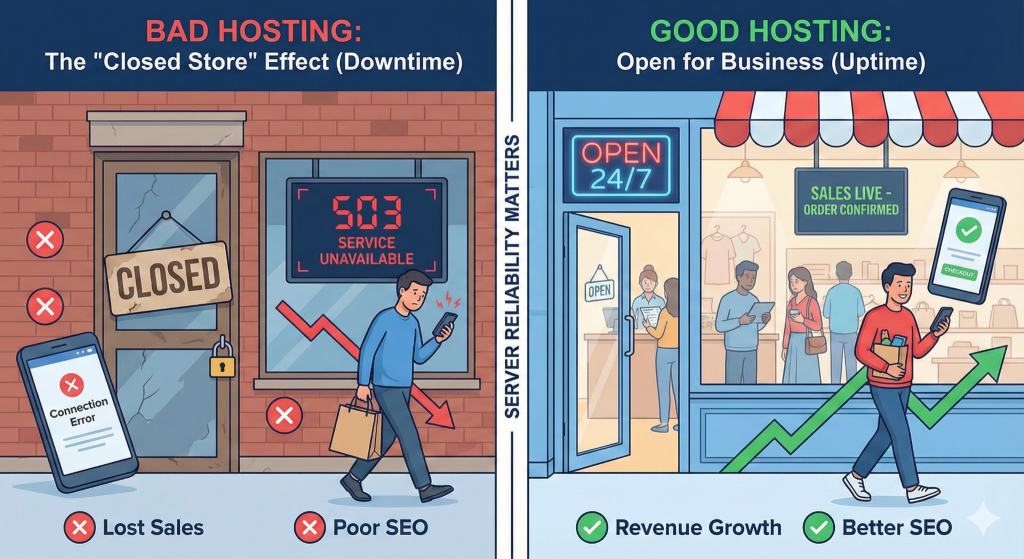
    2. Downtime: The “Closed Store” Effect

    Nothing illustrates how web hosting affects sales more clearly than downtime.

    If you are on a cheap shared hosting plan, your site might go offline during traffic spikes, exactly when you have the most potential customers trying to buy.

    • The Trust Factor: If a new client visits your site and sees a “503 Service Unavailable” error, they don’t come back later. They go to your competitor.
    • The “Noisy Neighbour” Risk: On shared hosting, you share resources with hundreds of other sites. If one of them gets a virus, your site crashes. Your sales stop instantly.

    Frequent downtime extends its negative impact beyond immediate revenue loss to cause lasting harm to your SEO rankings. When Google’s crawling bots repeatedly find your website offline, they flag it as unreliable or potentially abandoned. Many business owners fail to realise how web hosting affects sales through organic search rankings until they have already lost their position on Page 1. This repeated occurrence will cause Google to de-prioritise your pages, resulting in a dramatic drop in search rankings and the loss of hard-won organic traffic.

    Poor web hosting carries a significant reputational risk that is amplified by social media. Should your site fail during critical events like a product launch or a Black Friday sale, unhappy customers will not simply leave; they will publicly share their complaints on platforms like Twitter, Facebook, and various review sites. This negative “social proof” can deter potential customers for months, illustrating that the actual cost of choosing inexpensive hosting far exceeds the minor monthly savings.


    image
    24/7 SHOP

    3. Security Warnings: The Ultimate Trust Killer

    Modern shoppers are savvy. They look for the padlock icon (SSL) in their browser bar.

    Low-quality hosts often fail to auto-renew SSL certificates. If a customer sees a “Not Secure” warning from Chrome, they will not enter their credit card information. This is a subtle but deadly way in which web hosting affects sales by destroying trust right before the purchase happens. In this scenario, your hosting provider isn’t just failing you technically; they are actively blocking your sales.

    4. The “Hidden” Costs of Cheap Hosting

    When business owners ask how web hosting affects sales, they often look at the monthly price tag first. They see a plan for 300 KES/month and think they are saving money.

    This is a dangerous illusion. Cheap hosting usually comes with hidden costs that drain your budget later:

    1. No Automatic Backups: If your site gets hacked or an update breaks your design, cheap hosts often charge you a massive fee to restore it or tell you it’s gone forever.
    2. Paid Migrations: When you inevitably outgrow the slow server, they may charge you to move your files.
    3. Zero Developer Support: If you have a technical error, cheap support teams will send you a link to a generic article. You end up having to hire an expensive developer to fix a problem that a premium host would have fixed for free.

    The Math is Simple: If you save 500 KES a month on hosting but lose one customer worth 5,000 KES due to downtime, you haven’t saved money. You have lost profit.

    Comparison Table: Is Your Host Helping or Hurting?

    Use this table to quickly check if your current provider is optimised for sales growth.

    FeatureThe “Sales Killer” HostThe High-Value Host
    Uptime98% (Down frequently)99.9% Guaranteed
    Speed ImpactSlow server response (>600ms)Optimised caching (<200ms)
    SecurityPaid SSL / No backupsFree SSL / Daily backups
    ScalabilityCrashes during sales/promosScales resources instantly

    How to Fix It: A 3-Step Diagnostic Checklist

    Now that you understand how web hosting affects sales, here is how to audit your site in 5 minutes:

    • Run a Waterfall Test: Go to Gtmetricx. If the “Server Wait Time” is the longest bar, your host is the bottleneck.
    • Monitor Uptime: Use a free tool like UptimeRobot. If your site dips below 99.9%, it is time to move.
    • Check Support Speed: Open a chat with your host. If they take 30 minutes to reply, they won’t be there to help you when your site crashes during a sale.

    Read our guide on How to Choose the Best Web Hosting Services for Your Business to avoid these risks.

    Stop Losing Sales to Poor Hosting

    You shouldn’t have to worry about your website crashing during a sale or losing customers to slow loading times. Your hosting should be an asset, not a liability.

    At Elon’s Design, we understand exactly how web hosting affects sales, which is why we provide high-performance hosting optimised for stability. We offer the best web hosting in Nairobi, web hosting in Kenya, handling the migration, security, and speed optimisation so you can focus on running your business.

    🚀 Ready to speed up your site? View Our Premium Hosting Packages Here

    Case Study: The Cost of a 1-Second Delay

    Let’s look at a hypothetical scenario to visualise exactly how web hosting affects sales in a real business.

    Imagine an online shoe store in Nairobi:

    • Monthly Visitors: 10,000
    • Average Order Value: 3,000 KES
    • Conversion Rate: 2%
    • Monthly Revenue: 600,000 KES

    Now, imagine their hosting creates a 1-second delay. According to industry data, this drops conversions by 7%.

    • New Conversion Rate: 1.86%
    • New Revenue: 558,000 KES
    • Loss: 42,000 KES per month.

    That is 504,000 KES lost per year, all because the business owner wanted to save a few coins on a cheap shared hosting plan. Do not let this happen to you.

    Frequently Asked Questions (FAQ)

    Does hosting affect SEO? Yes. Google uses page load speed as a ranking factor. Slow hosting leads to lower rankings, meaning fewer customers find your store.

    What is the best type of hosting for high sales? For a high-traffic e-commerce business, VPS or Managed Cloud Hosting is best. It ensures dedicated resources so your site never slows down during traffic spikes.

    How much does bad hosting cost a business? It is estimated that small businesses lose thousands of dollars annually due to “micro-outages” and slow load times that cause customers to abandon their carts.

    Is it hard to switch to a new hosting provider? Many business owners stay with bad hosts because they fear breaking their site. However, premium providers (like Elon’s Design) offer managed migration services. We move your files, databases, and emails to the new high-speed server with zero downtime, so your sales never stop during the transfer

    Conclusion on How Web Hosting Affects Sales

    Your website is your 24/7 storefront. You wouldn’t build a brick-and-mortar store on a sinkhole just to save rent money. Don’t do it online.

    Understanding the direct link between hosting and revenue is the first step to reclaiming your lost sales. Investing in quality hosting is often the highest-ROI change you can make for your business.

    Stop tolerating slow speeds. Your revenue deserves better.


    Email: [email protected]

    Call / WhatsApp: +254 724 636 436


  • Best Web Hosting for Small Business: 4 Tips for Success 

    Best Web Hosting for Small Business: 4 Tips for Success 

    If you are looking for the best web hosting for small business success, you need to understand that your hosting provider is the foundation of your entire digital presence. It’s that simple.

    What is Web Hosting and Why Does it Matter?

    Think of your website as a house. Your domain name is the street address (e.g., yourbusiness.co.ke), but web hosting is the plot of land the house sits on. If you build a mansion on unstable, swampy land, it doesn’t matter how nice the house is; it’s going to sink. The same applies to your website: without the best web hosting, your site will be slow, insecure, and unreliable.

    For small businesses, choosing from the many best web hosting services available can be confusing. The market is flooded with technical jargon and massive price differences. In this guide, we will cut through the noise to help you identify the best web hosting sites that ensure your business stays fast and secure.

    Why You Need the Best Web Hosting

    Many founders treat hosting as an afterthought, looking for the cheapest option to tick a box. This is a critical mistake. Your hosting provider is your business partner. They are responsible for:

    • Speed: How fast your pages load (crucial for keeping visitors on your site).
    • Reliability: Ensuring your digital “shop” is actually open for business.
    • Security: Protecting your customer data from threats.

    Let’s answer the Question, what is Web hosting?

    Web Hosting is essentially the “home” where your website lives on the internet.

    How It Works

    When you buy hosting, you are renting space on a physical server (a powerful computer that runs 24/7) stored in a data center. When someone types your domain name into their browser, their computer connects to that server, and the server sends your website files back to them.

    What Defines the Best Web Hosting for Small Businesses?

    You don’t need to be an IT expert, but you do need to know the difference between the main options. To choose the best web hosting for small business needs, you must understand these three categories:

    • Shared Hosting – You rent space on a server along with hundreds of other websites. You share resources like “water and electricity” (CPU and RAM).
    • VPS (Virtual Private Server) – You still share a physical building, but you have your own dedicated unit with your own resources that no one else can touch.
    • Dedicated Hosting – You have entire servers just for yourself, or a network of servers ensuring 100% redundancy.

    4 Factors to Find the Best Web Hosting Services

    When looking for the best web hosting for small business sites, ignore the marketing fluff and look at these four specs:

    1. Uptime Guarantee (Aim for 99.9%): This refers to how often your website stays available online. When customers try to access your website and find it offline, the trust you have built begins to crumble instantly. A low uptime rate means lost revenue and missed opportunities.

    Your website functions as a 24/7 salesperson for your business, making constant accessibility essential. A truly reliable hosting provider must guarantee at least 99.9% uptime. This high standard ensures your online presence remains strong and accessible to customers at any time, day or night.

    Consistent uptime is more than just a statistic; it is a measure of your digital reliability and builds confidence with your customers. To achieve this dependability, your hosting infrastructure needs robust monitoring systems that are capable of detecting and resolving issues proactively. This kind of early detection prevents unexpected downtime, keeping your website stable and available when it matters most.

    1. Server Technology (SSD): Ensure they use SSD drives (modern, fast storage) rather than old spinning hard drives. This is the #1 factor in website speed. Server technology significantly affects how fast and reliable your website feels to visitors. One of the best upgrades you can choose is SSD hosting. SSD stands for Solid State Drive, a modern type of storage that performs much faster than traditional hard drives. When your hosting provider uses SSD servers, your website loads faster, processes data quickly, and manages traffic better. This results in smooth navigation, quick page transitions, and overall improved performance. 

    Unlike older HDD drives, SSDs have no moving parts, allowing instant data access. This cuts down the time it takes for your pages, images, and scripts to load, making your website feel light and responsive. For businesses, this speed advantage is vital because even a one-second delay can reduce conversions and impact customer satisfaction. SSD hosting also manages multiple users more effectively, so your site remains stable during traffic spikes or peak hours. When choosing a web hosting provider, opting for one with SSD technology is a smart choice that directly affects your speed, SEO, and user experience.

    1. SSL Certificate Included: The little padlock icon next to your URL that secures data. Google penalizes sites without it. Good hosts include it for free. When your hosting provider includes SSL, it means your website is automatically protected by secure encryption. This encryption ensures that any information exchanged between your site and your visitors, such as names, emails, passwords, or payment details, remains private and safe from cybercriminals. The presence of SSL is shown by the small padlock icon in the browser, which immediately signals to visitors that your website is secure and trustworthy.

    Beyond user trust, SSL also improves your website’s search engine ranking. Google prioritizes secure websites, meaning sites with SSL may appear higher in search results compared to unsecured ones. When your hosting provider includes SSL for free, you’re not only saving money, you’re also gaining a major advantage in visibility, performance, and customer trust. Overall, SSL is a must-have for every business website, and choosing a host that provides it automatically sets you on the right path.

    1. 24/7 Support: Websites rarely break at convenient times. You need a team that responds instantly, not an email ticket system that takes 48 hours. Look for hosts that offer 24/7 customer support through live chat, email, or phone. When a problem happens, you want quick solutions, not robotic responses or long waiting times. Fast support prevents downtime and helps your business maintain its credibility.

    Quality support teams don’t only fix problems, they guide you through challenges and offer expert advice. With the right hosting provider, you’ll feel supported every step of the way, especially during technical emergencies.

    Don’t Build on Swampy Land: Select the Best Web Hosting for your business

    Your website is likely the first interaction a new customer has with your brand. Don’t let a slow, unreliable hosting connection ruin that first impression.

    At Elon Designs, we specialize in providing the best web hosting for businesses in Kenya and beyond. We handle the technical heavy lifting so you can focus on running your company.

    Ready for a faster website? Click here: cloudelona.com to View Our Secure Hosting Packages or Contact Our Team for a Free Consultation.

    Email: [email protected]

    Call / WhatsApp: +254 724 636 436