The Invisible Brand: Why SEO Is No Longer Enough in 2026
Traditional search is dead. If you are still obsessing solely over Google’s blue links while ignoring how ChatGPT, Gemini, and Perplexity talk about your brand, you are losing 40% of your potential traffic.
As entrepreneurs, we can’t afford to be invisible. Generative Engine Optimization (GEO) is the shift from “ranking for keywords” to “becoming the cited authority.” A 2024 Princeton study proved that simple GEO tweaks, like adding authoritative data and structured citations, can increase your brand’s visibility in AI answers by up to 40%. This isn’t just a trend; it is the new standard for digital survival.
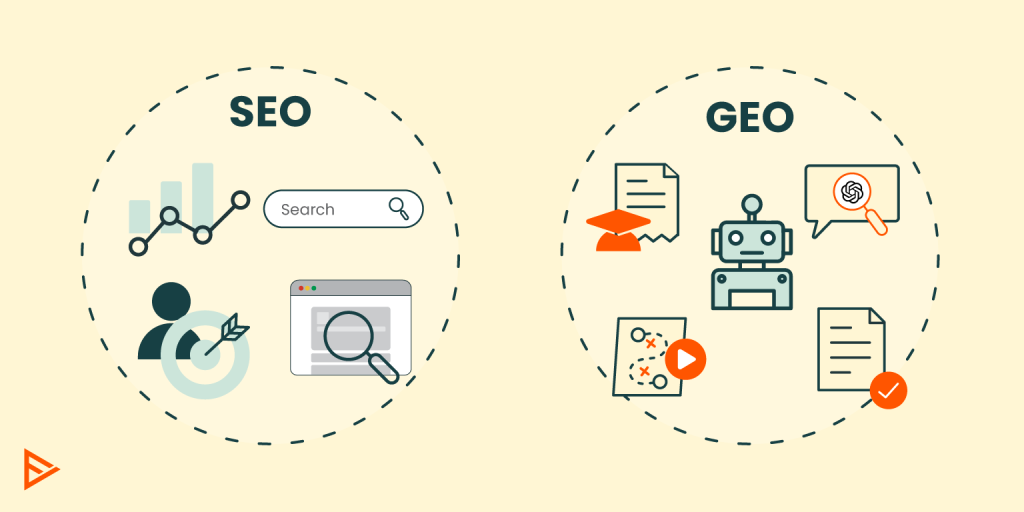
SEO vs. GEO: What’s the Real Difference?
While SEO focuses on getting a “click,” GEO focuses on getting a “mention.”
| Feature | Traditional SEO | Generative Engine Optimization (GEO) |
| Primary Goal | Rank #1 on Google Search | Be the “Cited Source” in AI answers |
| Key Metric | Click-Through Rate (CTR) | Brand Citations & Mentions |
| Content Style | Keyword-dense articles | Structured, authoritative facts |
| User Intent | Finding a list of links | Getting a direct, synthesized answer |
7 Proven GEO Strategies for Entrepreneurs
1. Kill the Fluff: Answer Questions with “Zero-Click” Precision
AI engines are “answer machines.” They don’t want to read a life story; they want to solve a problem instantly. To rank in a Gemini or Perplexity response, your content must be the cleanest source of truth available.
- The Strategy: Put the answer in the very first paragraph. Use the “Direct-Response Model.”
- The Proof: AI engines prioritize content that is easy to summarize. If you can’t explain your product in one sentence, an AI won’t do it for you.
2. Hierarchy Over Hype: Use Logical Architecture
AI tools “crawl” your site to extract facts. If your blog is a wall of text, the AI will skip it for a competitor who uses Schema and Structured Headings. The Strategy: Use one H1, then H2s for main points, and H3s for details.
- The Result: A clearer hierarchy leads to better “Rank Math” scores and easier extraction by AI bots.
3. Build “Topical Clusters” to Prove Expertise
AI favors websites that show niche authority rather than one-off posts. If you want to be the “expert” in AI’s eyes, you need to own the topic.
- The Strategy: Link your blogs together. If you write about “GEO Tools,” link it to “GEO for Startups” and “GEO Case Studies.”
- Internal Linking: This creates a “web” of information that proves to the AI you aren’t just guessing you are an expert.
4. Inject “Trust Signals” (Data & Experience)
AI filters out “generic fluff.” To be cited, your content needs E-E-A-T (Experience, Expertise, Authoritativeness, and Trustworthiness).
- The Strategy: Include original data, author bios, and real-world case studies. The Fix: Replace “Many people say…” with “According to our 2025 internal audit…”
5. Write for Natural Language (Entities, Not Keywords)
People don’t talk to AI like they talk to Google. They ask questions: “How do I fix my SEO?”
- The Strategy: Focus on “Entities” (your Brand Name + your Niche).
- The Fix: Use conversational phrases. Instead of “SEO services Nairobi,” use “How our Nairobi-based agency helps entrepreneurs master SEO.”
6. Provide Actionable Frameworks and Lists
AI engines love Step-by-Step guides. They are the easiest content type for a bot to scrape and present as a “how-to” answer.
- The Strategy: Use numbered lists for processes.
- The Stat: Frameworks can boost AI citations by up to 67% because they provide immediate utility to the user.
7. The “Freshness” Audit
Information moves fast. AI engines like Perplexity prioritize recent data over old archives.
- The Strategy: Refresh your top-performing blogs every 3–6 months.
- The Fix: Update your statistics and add a “Last Updated” date to signal to the AI that your content is still relevant.
The Bottom Line: Help First, Sell Later
GEO is about becoming so useful that the AI has no choice but to mention you. Most of your competitors are still stuck in 2022. By implementing these seven steps today, you are future-proofing your business for 2026 and beyond.
Which of these GEO tactics will you implement first? Let’s discuss in the comments below.
Frequently Asked Questions About GEO
- What is the main difference between SEO and GEO?
Traditional SEO focuses on ranking in Google’s blue links. GEO (Generative Engine Optimization) focuses on getting your brand cited as an authority within AI responses from tools like ChatGPT and Perplexity.
- Does traditional SEO still work?
Absolutely. SEO is the foundation (site speed, mobile optimization), but GEO is the “authority layer” that ensures AI models trust your data enough to recommend it to users.
- How do I start with GEO today?
The fastest way is to add Schema Markup and ensure your blog answers a specific question in the very first paragraph.
- Is GEO only for big brands?
No. Small businesses and entrepreneurs can actually beat big brands in GEO by providing niche-specific, high-quality data that general websites overlook.
Leave a Reply